

Tested and Proven: The Matrix Glute Trainer


This whitepaper analyzes the effectiveness of the Matrix Glute Trainer in glute and hamstring muscle building.
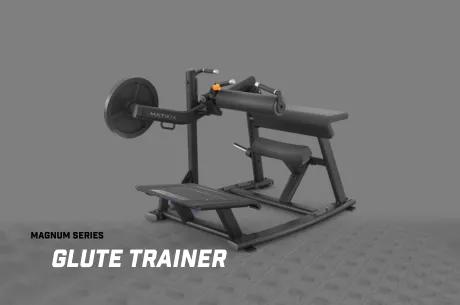
How the Matrix Glute Trainer Was Designed
When our industrial designers and product engineers teamed up to create our new Matrix Glute Trainer, the goal was to target the glutes and hamstrings with an exercise just as effective as hip thrusting without the difficulty and discomfort of using a weighted straight bar. Matrix commissioned an in-depth study in collaboration with a professional project engineer and a biomechanics consultant to substantiate the benefits of our design. Drawing on scientifically validated testing procedures, our experts confirmed that the Glute Trainer targets the glutes and hamstrings more effectively than a traditional hip-thrust exercise with a weighted straight bar.
Scientifically Validated Methods
To begin, our experts enlisted six participants — three men and three women — who were injury-free and familiar with hip-thrust exercises using a weighted straight bar. Each participant had a total of 12 EMG sensors applied to the major muscles of their quads (rectus femoris, vastus medialis and vastus lateralis), hamstrings (biceps femoris) and glutes (gluteus maximus and gluteus medius) to measure muscle activation via electromyography. We also fitted participants with 22 reflective nodes to be used with an accredited motion capture program, ensuring that movement patterns and participant form was consistent for each trial. Next, we asked participants to complete a maximum voluntary contraction of each of the major muscle groups listed above. With this upper limit established for each participant, our experts could measure the amount of relative muscle activation created by each training method and compare.
Conditions and Testing
Participants were instructed to perform approximately 30 seconds of exercise with the Matrix Glute Trainer and the weighted straight bar under three different conditions: at 25 pounds (11.3 kilograms) for both male and female participants; at 35 pounds (15.9 kilograms) for female participants and 45 pounds (20.4 kilograms) for male participants; and at 25 pounds for both male and female participants with a resistance band around the knees to encourage abduction of the knees and thereby better activate the glutes.
Two trials were completed for each condition with rest in between to ensure the accuracy of our results. Our experts also distinguished between the muscles that were the primary movers for the hip-thrust motion (glutes and hamstrings) and the muscles that were in a stabilizing role (quads). They then used motion capture technology in coordination with EMG sensors to measure the muscle activation of the primary movers at the start, peak and end of the hip-thrust motion. With these data points, they were able to determine the average muscle activation for each rep.
Targeting the Glutes & Hamstrings: Matrix Glute Trainer Study Results
After careful analysis of the muscle activation data collected via EMG sensors, our experts found that the activation levels of the glutes and hamstrings were virtually identical when using the Matrix Glute Trainer and when hip thrusting with a weighted straight bar. The major muscles of the quads, on the other hand, showed significantly less activation when using the Glute Trainer in comparison to hip thrusting with a weighted straight bar. Since the quads are not activated nearly as much when using the Matrix Glute Trainer, the participant was able to better focus their effort on their glutes and hamstrings. When the effectiveness of the Glute Trainer is combined with the comfort and convenience of its design, the new Matrix Glute Trainer stands alone as a superior solution for exercise enthusiasts who want to build and tone their glutes and hamstrings.

