The Overlooked Link Between Women’s Stress and Bone Health


Women are reporting some of the highest stress levels observed in modern surveys. Across 146 countries, the odds of reporting stress nearly doubled between 2006 and 2023, with women consistently reporting higher stress levels than men.1 Many are experiencing this in midlife, during the same decades that bone and muscle loss begin to accelerate.2 At the same time, women are increasingly interested in resistance training, healthy aging and longevity. These trends are converging in a way that creates an important opportunity for fitness professionals. Resistance training can be positioned as more than exercise. It is an investment in lifelong resilience.
Bone Needs a Reason to Stay Strong
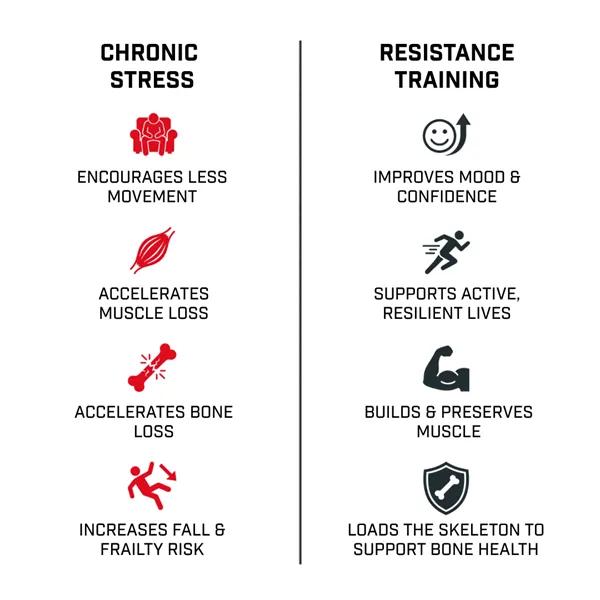
Bone is a living tissue that responds to challenge. During resistance training, muscles pull against bone and the skeleton receives a signal to stay strong. When physical challenges become less frequent or less demanding, the bone gradually becomes weaker.
Most women become less active as they age or shift toward lower-intensity activities. Walking and recreational exercise remain valuable for mobility and cardiovascular health, but improving bone strength requires progressively greater mechanical loading than everyday activities provide.3 Muscle loss compounds the problem, because while stronger muscles create greater forces on bone, weaker muscles reduce the forces needed to preserve bone strength.
Reduced physical loading is only one challenge women face. Growing evidence suggests that chronic stress may further accelerate declines in bone and muscle health.4 Resistance training addresses several of these challenges simultaneously by increasing skeletal load, preserving muscle and improving well-being.5
Progressive Loading Matters
Some of the clearest evidence that intensity is crucial for bone strength comes from studies in women with low bone mass. Compared with a low-intensity program, women who trained at high intensity using a progressive format showed improved bone mineral density, posture and physical function.3
The findings reinforce an important principle for fitness professionals: bone responds to progressively greater mechanical loading. Whether resistance comes from selectorized equipment, plate-loaded machines, free weights or compound movements, the goal is the same. The skeleton must continue receiving a meaningful mechanical challenge in order to maintain healthy bones over time.3
Bone Health Starts Before Osteoporosis
Few women begin working with a fitness professional because they are thinking about bones. They are far more likely to be motivated by desires for better stress management, increased energy, weight management or healthy aging. Bone health often becomes part of the conversation only after significant bone loss or a fracture has already occurred.
Fitness professionals have an opportunity to change that conversation. Resistance training can be presented as an investment in stronger bones, lifelong independence and psychological well-being, making it one of the few behaviors that simultaneously supports both mental and physical health.5
Four Ways to Support Bone Health
- Start the conversation before osteoporosis develops. Help members understand that bones respond to years of progressive loading. The earlier resistance training becomes a habit, the greater the opportunity to preserve bone health.
- Build confidence at every age. Although building bone earlier in life provides the greatest long-term advantage, ensure your members know that progressive resistance training remains one of the most effective ways to support bone health while improving strength, balance and posture.³
- Progress resistance, not just more repetitions. Bone responds to progressively greater mechanical loading. As members grow stronger, gradually increase the level of challenge so the skeleton continues receiving the stimulus needed to maintain bone health.
- Aim for a consistent, twice-a-week habit. Guidelines6 recommend resistance training all major muscle groups a minimum of two nonconsecutive days each week. Bone health is best maintained by consistent training performed over months to years.
Helping women build strength today may be one of the most meaningful ways fitness professionals can help protect their health and independence for years to come.

Karlie Intlekofer, PhD, CNC, CPT
References
- Canaletti et al. Rising tide of stress: Global trends and structural predictors over 18 years. Wellbeing Space Soc 2026; 10: 100319.
- Wright et al. The musculoskeletal syndrome of menopause. Climacteric 2024; 27(5): 466-72.
- Watson et al. High intensity resistance and impact training improves bone mineral density and physical function in postmenopausal women with osteopenia and osteoporosis: The LIFTMOR randomized controlled trial. J Bone Miner Res 2018; 33(2): 211-20.
- Ng & Chin. Potential mechanisms linking psychological stress to bone health. Int J Med Sci 2021;18(3): 604-14.
- Gordon et al. Association of efficacy of resistance exercise training with depressive symptoms: Meta-analysis and meta-regression analysis of randomized clinical trials. JAMA Psychiatry 2018; 75(6): 566-76.
- American College of Sports Medicine. ACSM's Guidelines for Exercise Testing and Prescription.12th ed. Wolters Kluwer; 2025.

